Rhossili's Famous Cliff Horses Removed After More Than 100 Years as Grazing Rights Dispute Escalates

For generations, horses grazing across the dramatic cliffs and open countryside of Rhossili Common have been part of the landscape of Gower. For visitors, residents and photographers, seeing the animals roaming across the headland has become almost as much a part of the Rhossili experience as the famous coastline itself.
Now, that tradition has been brought to an abrupt halt.

Horses that have grazed Rhossili Common for more than a century have been removed following months of disagreement surrounding grazing rights, the number of animals on the land, visitor safety and the future management of the common.
The removal has exposed a much bigger argument about who gets to decide what happens on some of Wales's most treasured landscapes — and whether traditional farming practices can continue alongside the demands of modern tourism, conservation and public safety.
A landscape suddenly missing one of its most recognisable sights
The horses have long been associated with Rhossili and the wider Gower landscape.
Their presence on the cliffs has helped create the distinctive rural character of the area, where farming, wildlife, tourism and dramatic coastal scenery exist side by side.
But according to the National Trust Cymru, concerns had been growing about the number of horses grazing on the common.
The organisation, which owns the land, said it had been reviewing the number of animals on Rhossili Common because it believed the horses were exceeding the agreed grazing limit.
It also raised concerns about safety after a stallion repeatedly escaped through a pedestrian gate.
According to the trust, the animal had pushed through visitors before making its way towards the road, car park and village.
That creates an obvious dilemma.
A horse wandering freely across a beautiful common may be an attraction to visitors. The same horse moving towards a busy road or through a crowded tourist area can quickly become a serious safety problem.
The National Trust says its concerns were therefore not simply about the appearance of the common or the number of animals, but about public safety, animal welfare and the ecological health of the land.
Farmers say the pressure became too much
For the farmers involved, however, the dispute has become deeply personal.
Rob Morgan, who runs Rhossili Sunflowers and Gower Fresh Christmas Trees, announced the removal of the horses in a video posted on social media.
Morgan and fellow farmer Nicky Beynon said they had experienced increasing pressure over the animals.
Beynon described the previous 18 months as extremely difficult, saying the dispute had made their lives "hell".
The horses were eventually herded away from the common.
For those involved in farming the land, this is not simply a disagreement about a tourist attraction.
Grazing rights on common land have deep historical roots, often stretching back generations. They form part of the relationship between farming communities and the land they work.
That makes disputes over those rights particularly sensitive.
The question is not simply how many horses should be on the cliffs?
It is also:
Who has the authority to decide?
The National Trust says it never asked for the horses to be removed
The National Trust Cymru has strongly disputed the suggestion that it ordered the horses off the common.
The organisation says it had "at no stage" asked for all the horses to be removed.
Instead, it says it was reviewing the number of animals that should be allowed to graze under the relevant commoner's rights.
The trust says it is waiting for confirmation of those rights before determining how many horses could potentially return.
That distinction matters.
From the farmers' perspective, the animals have been removed after months of pressure.
From the National Trust's perspective, the organisation was attempting to establish what the correct grazing level should be and address concerns about safety and land management.
Both sides therefore tell a very different story about how the situation reached this point.
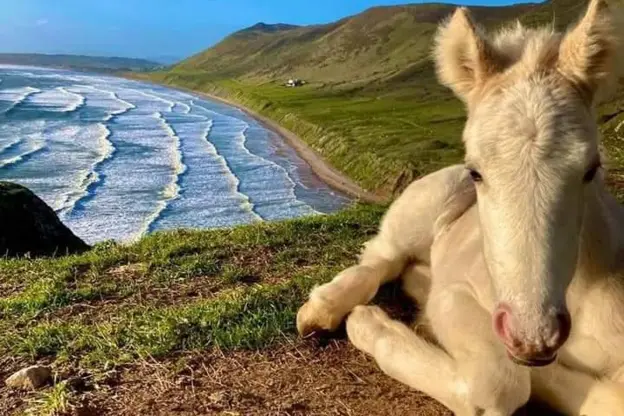
But what happens to the horses now?
The immediate consequence is perhaps the most visible one.
The cliffs look different.
The horses that visitors had become accustomed to seeing have gone.
For some people, that will be a relief if they were concerned about safety.
For others, it represents the loss of something that made Rhossili special.
The sight of horses roaming across the open landscape has become part of the area's identity. Their disappearance could therefore have an impact beyond the farming dispute itself.
Rhossili is one of Wales's most recognisable tourist destinations.
People travel from across Wales, the UK and beyond to experience its coastline, beaches, countryside and views.
The horses have been part of that experience.
Their removal inevitably raises questions about whether the landscape people have known for generations is beginning to change.
Conservation versus tradition
At the heart of this dispute is a difficult question facing rural communities across Wales.
How do we balance traditional land use with conservation and modern expectations?
Grazing animals can play an important role in managing landscapes. At the same time, too many animals can damage vegetation, affect habitats and create welfare concerns.
Then there is tourism.
Thousands of people can visit popular beauty spots, creating an environment that would have been almost unimaginable when traditional grazing arrangements were established.
A common that worked perfectly well for generations may face entirely different pressures today.
More visitors.
More cars.
More infrastructure.
More people walking across the land.
And greater expectations around public safety.
That does not mean traditional farming should simply be pushed aside.
Nor does it mean conservation concerns should be ignored.
It means difficult compromises have to be found.
The bigger question for Wales
The Rhossili dispute should prompt a much wider conversation about the future of Wales's rural landscapes.
Across the country, traditional farming communities are increasingly being asked to operate within a complicated system of environmental regulations, conservation priorities, tourism pressures and changing land-management expectations.
At the same time, organisations responsible for protecting important landscapes have their own responsibilities.
They have to protect wildlife.
They have to manage visitor numbers.
They have to consider public safety.
And they have to ensure that land is managed sustainably for future generations.
Those responsibilities can sometimes collide.
Rhossili is now an example of what happens when those competing priorities become impossible to reconcile without conflict.
A tradition should not disappear without a serious conversation
There is a danger that debates like this become reduced to one side being labelled "anti-farmer" and the other "anti-conservation".
That would miss the point.
The farmers have legitimate concerns about their traditional grazing rights and the future of their relationship with the land.
The National Trust has legitimate responsibilities towards visitors, animals and the environment.
The challenge is finding a solution that recognises both.
If the grazing rights allow horses to return, there needs to be a workable system that protects visitors and keeps the animals safe.
If the number of horses genuinely needs to be reduced, that decision should be based on clear evidence, transparent rules and meaningful engagement with the farmers who hold the grazing rights.
And if there are disagreements about what those historic rights actually allow, the answer cannot simply be endless arguments through social media and public statements.
There needs to be a proper process.
Rhossili deserves better than a permanent stand-off
The most disappointing outcome would be for Rhossili to become permanently divided between farmers and landowners, with the horses becoming casualties of an unresolved dispute.
The horses themselves cannot speak.
The visitors cannot determine the grazing rights.
And the landscape cannot decide how it should be managed.
Those decisions have to be made by people.
That means sitting around a table, examining the historic rights, considering the evidence about grazing levels and safety, and finding a solution that works.
Perhaps fewer horses could graze the common.
Perhaps additional safety measures could be introduced.
Perhaps particular areas could be managed differently.
Perhaps new arrangements could be established around gates, fencing, visitor routes or monitoring.
There may be several possible solutions.
What matters is that the argument does not become more important than the landscape and community it is supposed to protect.
A symbol of a changing Wales
The removal of Rhossili's horses is about far more than horses.
It is about the changing relationship between rural Wales and the people who visit it.
It is about ancient grazing rights meeting modern land management.
It is about farming traditions meeting conservation.
And it is about whether the landscapes that generations have inherited can continue to look and feel the same in a rapidly changing world.
The cliffs of Rhossili will remain.
The sea will continue to crash against the Gower coastline.
Visitors will continue to arrive.
But for now, something is missing.
The horses that had become part of the character of Rhossili for more than 100 years have been moved away — leaving behind an uncomfortable question for everyone involved:
Can Wales protect its landscapes and its communities without sacrificing the traditions that helped create them?
That is the conversation Rhossili now needs to have.


Comments